When somebody kinds "fast first aid course near me" right into a search engine, there is normally a factor. A workplace due date. A brand-new child in the house. A mentoring duty that begins next week. Or a scare that made it clear exactly how susceptible we are when no person neighboring recognizes what to do.
Speed belongs. I have reserved a lot of express first aid courses for workplaces and sporting activities clubs where people simply could not spare numerous days. I have also seen the flip side: people walking out of a "fast certification" session with a shiny first aid certificate and very little genuine confidence.
The objective is not just a quick course. The objective is the appropriate fast first aid training for your circumstance, with enough deepness to be helpful when it matters.
This guide walks through just how skilled trainers actually evaluate first aid and CPR courses, what to look for when the service provider assures "express", and how to match a fast course to your real risks and obligations.
What "fast" needs to and need to not mean
Most companies now advertise fast first aid, express first aid, or fast cpr courses. The tag itself does not tell you a lot. The trick is what has actually been shortened, and how.
There are 3 usual means a course is made "fast" without giving up too much top quality:
First, some concept is relocated online. A blended first aid and CPR course will ask you to complete e‑learning beforehand, then concentrate the classroom time on CPR training, bandaging, use an AED, and technique circumstances. The complete understanding time is comparable, however the face‑to‑face day is shorter.
Second, the course extent is narrower. A brief express CPR course or fast cpr refresher course could cover just cardiopulmonary resuscitation and defibrillator usage, without subjects such as burns, cracks, or environmental emergency situations. For some functions this is suitable. For others it is not.
Third, the team size is kept small and the routine is limited. A concentrated group with a great trainer can finish a complete first aid and CPR course much faster than a big, slow‑moving class packed with side conversations.
Red flags show up when "fast first aid course" equates to hurried demonstrations, little hands‑on practice, and assessments that seem like a box‑ticking workout. When someone is not breathing, speed will certainly not help you if you can not bear in mind just how to position your hands or what deepness of compressions to aim for.
If you are drawn to express first aid courses as a result of time pressure, that is understandable. The key is to understand exactly what you are trading for that shorter timetable.
What a beneficial first aid course actually covers
Before comparing "fast" options, it aids to understand what a solid first aid training day should include. Names differ by supplier, however the core aspects of a skilled first aid and CPR course often tend to be similar.
At minimum, a basic first aid course for neighborhood members ought to cover:
- Recognising an emergency situation, checking for danger, and asking for help CPR training on grownups, including compressions and rescue breaths or hands‑only CPR, depending on guidelines Use of a computerized exterior defibrillator (AED) Management of choking in adults and children Control of severe blood loss and shock Basic look after burns, fractures, and sprains Dealing with unconscious yet breathing casualties, consisting of the recovery position Recognition of cardiac arrest, stroke, and anaphylaxis, and just how to support the person till advanced help arrives
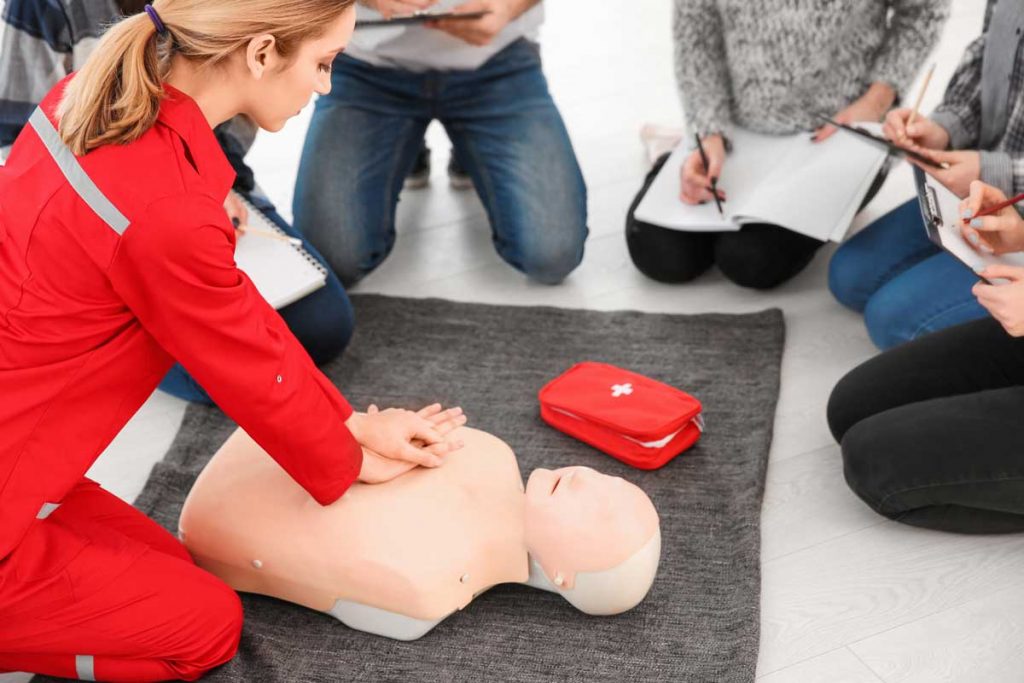
Courses that discuss "first aid and cpr training classes" ought to additionally include functional sessions where you really kneel next to a manikin and carry out compressions, not simply view an instructor.
Specialised groups require much more. An express childcare first aid course, for instance, must include infant CPR, administration of usual childhood years injuries, allergies, and bronchial asthma, plus demonstration of how to maintain a hurt kid tranquility and safe. Express child care first aid training that does not provide you time to practice baby CPR several times is not offering you.
When you see "fast first aid courses" marketed greatly, ask yourself: could every one of that be meaningfully covered in the time promoted, with 8 to 12 individuals practicing and asking questions? If the answer really feels doubtful, dig deeper.
Certificates, accreditation, and what they really mean
Many individuals are chasing after a first aid certificate because their company, regulator, or expert body requires one. Because context, not all certificates are equal.
Reputable first aid and CPR courses are commonly lined up with national or local guidelines. Relying on your nation, that might indicate acknowledgment by a federal government authority, a workplace safety and security regulatory authority, or a significant voluntary help organisation.
Look for 3 points:
Accreditation or recognition. For workplace functions, a fast first aid course ought to satisfy the appropriate job-related health and safety or childcare standards in your area. If the site is obscure, call and ask which standard the certificate aligns with.
Assessment with actual criteria. To issue a trustworthy first aid certificate, the provider must examine you versus clear end results such as CPR method, risk-free use of an AED, and basic wound monitoring. This does not require to feel like an examination, yet it ought to be more than just signing the participation sheet.
Clear expiration and refresher support. CPR abilities degrade quickly, which is why many organisations call for CPR refresher training every one year, also if the broader first aid qualification lasts 2 or 3 years. Well run fast cpr refresher courses will concentrate almost totally on compressions, rescue breaths if suitable, and AED operation, with duplicated practice.
Fast certification is eye-catching, however if you later on uncover that the certificate is not accepted by your employer or specialist board, you have actually lost both time and money.
Matching the course to your genuine needs
Not everybody needs the same degree of first aid training. Prior to you click "publication", time out and specify what you actually require to be able to do.
If your company has specified a particular device code, course name, or service provider listing, that precedes. As an example, particular workplaces call for a full occupational first aid course, not a basic express first aid choice. Do not depend on the course title alone, as "standard", "fundamental", and "job-related" can mean various things in various systems.
Parents and carers frequently benefit most from a course that is hefty on CPR, choking, injuries in youngsters, high temperature, and first aid pro Cannon Hill allergic reactions. Express childcare first aid courses are developed with this focus, and several timetable the sessions in the evening or on weekend breaks. Prior to you assume that "express" suggests superficial, examine whether the course provides a much longer practice segment on baby and youngster CPR and choking. Many do.
Sports trainers and health and fitness experts ought to gravitate toward first aid and cpr courses that mention strains, fractures, head injuries, unexpected heart attack, and exertional conditions such as warm illness. A fast cpr course might tick a standard insurance policy box, but it will certainly not aid much with a dislocated shoulder pitch side.
If you remain in a remote or high‑risk setting, ask if the carrier offers an innovative or remote first aid course. Trying to press that right into a half‑day express format is rarely wise.
When I aid organisations pick, I usually suggest a straightforward approach: initially, specify the most likely emergencies in your context; 2nd, make sure those subjects show up explicitly in the course synopsis; third, approve a slightly longer session if that is what it takes to cover them properly.
Different styles of "fast" first aid and CPR training
Once you know the web content you need, you can consider layout. Numerous "fast first aid training" deals now come under one of a couple of categories.
Blended courses. These integrate self‑paced online modules with a shorter practical session. As an example, you might complete 3 hours of e‑learning then go to a three‑hour face‑to‑face course concentrated on CPR training, AED use, and hands‑on bandaging. For adults that are comfortable with online discovering and can self-control themselves to complete it, this is an efficient format.
Short, focused CPR courses. A 90‑minute express cpr course or fast cpr session is typically planned as a stand‑alone CPR and AED upgrade or an initial area course. It is ideal for workplaces where numerous people simply require confidence in cardiac emergency situations, or for member of the family of someone with heart problem. It is not a total first aid course.
Express first aid days. Some organisations offer a one‑day express first aid course that covers both first aid and CPR, utilizing a mix of pre‑reading and extensive classroom job. The day is full, but you walk out with both first aid and cpr certification.
On website team training. For work environments or clubs, carriers will often compress some components by customizing scenarios specifically to your atmosphere. An express first aid training session delivered in your very own facility can really feel quicker because you are practising in the very same areas where emergencies may occur.
Purely on the internet first aid courses. These can be beneficial for theoretical understanding or as refresher courses in between formal courses, yet they can not change hands‑on CPR training if your role entails duty for others. Watch out for any type of supplier providing a complete first aid certificate based only on enjoying video clips and answering quizzes.
The right layout depends on your timetable, your understanding design, and how crucial useful abilities are in your context. A combined or express alternative can be the most effective of both worlds if you take the pre‑course work seriously.
A quick list prior to you book
Use this list to sanity‑check any type of fast first aid courses you are considering.
The course web content explicitly matches your function or danger account, not simply a common "first aid course". The carrier states what criterion or regulatory authority identifies the first aid certificate you will certainly receive. There is a clear breakdown of on the internet versus face‑to‑face hours, consisting of how much time is committed to CPR training and practice. Class size is minimal and there goes to least one manikin for every single 2 or three individuals during CPR practice. You can locate genuine evaluations that discuss the top quality of direction, not just "easy pass" comments.If any of these are missing out on, ask inquiries prior to you turn over your card details.
How to check out course descriptions like an instructor
After years of mentor, I can normally distinguish a course sales brochure whether I would certainly enjoy to teach there. You can use similar ideas as a possible student.
When a fast first aid course description is significant, it will certainly speak concretely about skills. As an example, "carry out undisturbed upper body compressions for 2 minutes" lugs more weight than "learn more about CPR". Seek verbs like "execute", "demonstrate", and "use" as opposed to simply "comprehend" or "recognize".
Pay attention to just how situation method is defined. Good first aid training consists of some kind of realistic circumstance: managing an unconscious person, treating a severe hemorrhage while one more trainee calls emergency situation services, or handling a choking kid role‑play. If the timetable is just lectures and videos, there is little area for constructing muscle memory.
An express cpr training session that still allows each individual a number of full cycles of compressions on a manikin, with feedback from the instructor, can be much more important than a longer course where half the class simply watches.
Be careful if the selling point is primarily regarding being very easy, fast, and calling for little effort. First aid and cpr courses need to be accessible, however they are additionally concerning preparing you for the worst day a person near you may have. Some sense of difficulty is appropriate.
What good teachers do in fast courses
The high quality of first aid and CPR courses lives or passes away with the teacher, especially when time is tight. In a pressed schedule, an experienced trainer readjusts on the fly, trims much less crucial conversation, and makes certain first aid trainer certification everyone gets hands‑on practice.
Experienced trainers in fast first aid courses will:
Speak in simple language and stay clear of unnecessary lingo. When time is restricted, clearness issues greater than showing off clinical terminology.
Demonstrate, after that coach. They maintain presentations tight and then invest the majority of the session flowing, correcting hand placements in CPR, or helping a nervous participant talk via a call to emergency situation services.
Contextualise for the team. If the space is full of child care employees, they invest more time on paediatric emergencies and much less on, say, industrial accidents.
Insist on secure technique, even if it takes an added few minutes. It is much better to leave one small topic a bit lighter than to allow every person walk out doing poor‑quality compressions.
If you can, ask associates or buddies that have actually taken fast first aid or express cpr courses lately which teachers or organisations they suggest. Word of mouth about how certain they really felt afterwards is much more valuable than shiny marketing.

Balancing cost, time, and genuine competence
Most people choosing a fast first aid course are managing budgets in addition to calendars. It is affordable to compare prices and try to find efficient alternatives, however be careful about incorrect economies.
An exceptionally affordable express first aid course that leaves you uncertain of what to do is not in fact great value. You may find yourself paying again for a much more detailed course after a frightening near‑miss, or discovering that your certificate is not recognised.
On the other hand, a longer or extra costly course is not immediately better. I have seen extremely ordinary courses extended across 2 days, with lengthy breaks and little focused technique. A well created six‑hour combined course can outperform a poorly structured eight‑hour one.
A valuable attitude is to assume in terms of expense per hour of top quality practice. How much time will you actually spend on the floor doing CPR training, bandaging, or circumstance work under guidance? That is where self-confidence builds.
For organisations, bear in mind the covert cost savings. A group that has completed properly structured first aid and cpr training classes is better able to react to events early, which can minimize intensity, lost time, and lengthy investigations.
Special situation: selecting express child care initial aid
Childcare experts frequently have the toughest mix of constraints: strict regulatory demands, long working hours, and the psychological weight of being in charge of other individuals's children.
When reviewing express child care first aid courses, be especially cautious that "express" describes the timetable, not to a decreased material listing that no longer satisfies governing standards.
Key points to validate consist of:
Infant and kid CPR in addition to grown-up CPR, with duplicated technique for both.
Management of choking in babies and kids, including what to do if the youngster ends up being unconscious.
Recognition and action to usual paediatric emergency situations such as asthma attacks, anaphylaxis, seizures, head injuries, and severe bleeding.
Clear assistance on when to call moms and dads, when to call emergency solutions, and exactly how to document cases in a childcare context.
Express childcare first aid training must also recognize the emotional side. Taking care of an actual emergency involving a kid is difficult. Instructors who have dealt with kids themselves can commonly share useful pointers for remaining tranquil and keeping the group of other kids safe at the very same time.

If a provider markets express childcare first aid courses but just details grown-up topics, keep looking.
Questions to ask a provider prior to you commit
A brief phone call or e-mail exchange can reveal a lot more about a course than any kind of sales brochure. Below are focused concerns that experienced trainees and security managers tend to ask.
Which criterion or regulatory authority identifies your first aid and CPR certificate, and is it appropriate for my duty or industry? How much time in the face‑to‑face session is invested in hands‑on CPR training and practical scenarios, not just lectures? What is the maximum class size, and how many manikins do you give per group? For mixed or express first aid courses, what happens if I do not finish the on the internet component prior to attending? How experienced are your instructors, and do you assign instructors with particular backgrounds for childcare, sports, or office courses?If the answers are vague, or you really feel pressured into booking rapidly, that tells you as high as any type of official review.
Keeping skills sharp after a fast course
No issue just how good the fast first aid course is, skills fade. Statistics vary, yet numerous studies recommend that CPR efficiency wears away substantially within 6 to 12 months without technique. That is why normal fast cpr correspondence course are so valuable.
You can likewise strengthen skills between formal courses by:
Reviewing your course handbook or relied on online resources every few months, particularly the actions for CPR and choking.
Mentally rehearsing what you would certainly perform in acquainted spaces, such as your workplace, health club, or home. Where is the nearest AED? Exactly how would you remove the location and require help?
Practising non‑technical abilities such as steadly giving instructions or delegating a person to satisfy the ambulance.
If you ever have to use your skills in a genuine case, consider booking an early refresher. Individuals commonly find knowledge spaces just when checked by reality.
Choosing well when speed matters
Searching for "fast first aid courses near me" is often the initial step towards taking responsibility in an emergency. Rate can be an ally, offered you deal with the course as a significant financial investment rather than a tick‑box exercise.
Look past the word "express" and focus on web content, certification, teacher high quality, and the amount of authentic technique you will certainly obtain. Suit the course to your genuine dangers, whether that is an active workplace, a football area, or a room full of toddlers.
The right fast first aid or express cpr course leaves you not just with a certificate, however with the peaceful confidence to advance when a person close by requires assistance. When that moment comes, you will certainly be glad you selected depth over advertising gloss, also if it suggested a somewhat longer day.